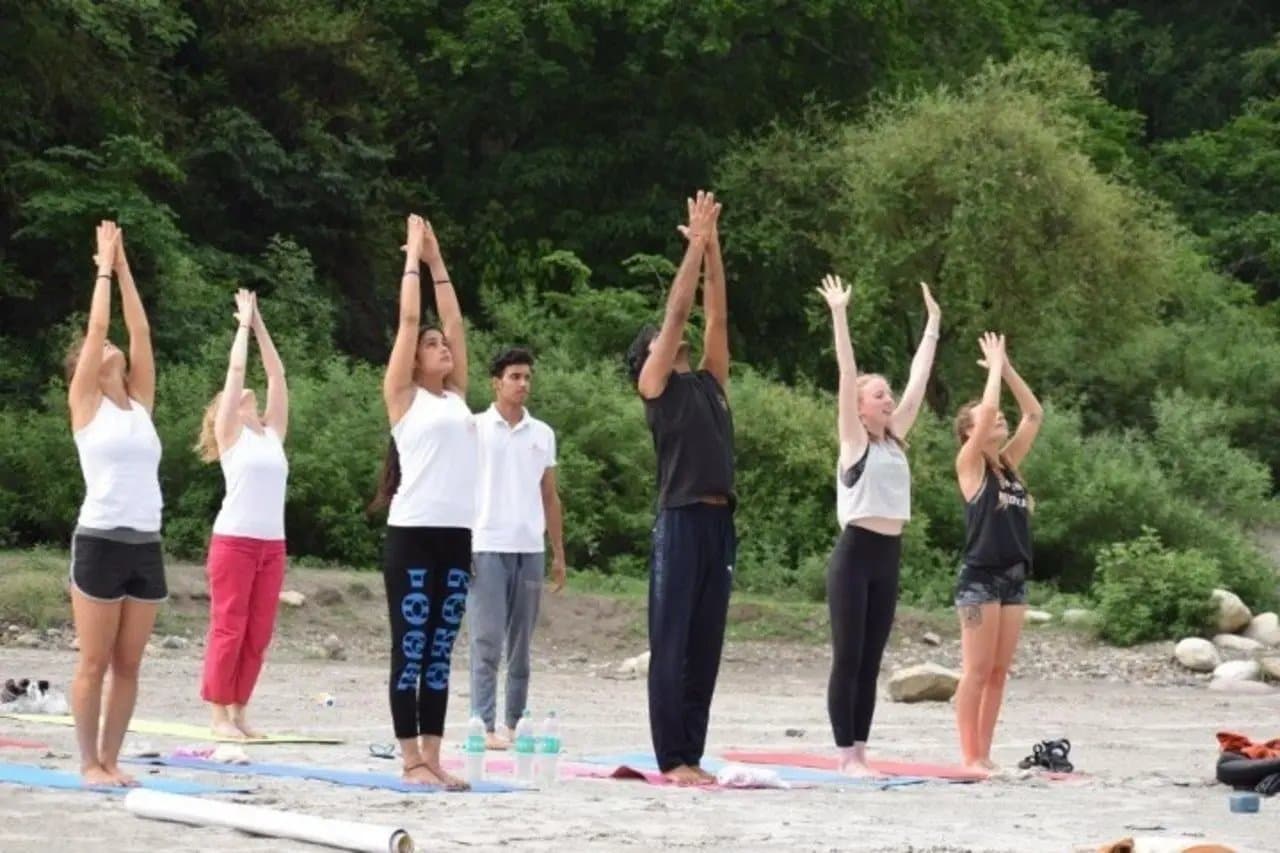
The 100 hour yoga teacher training in Rishikesh at Rishikesh Nath Yogshala costs $275 all-inclusive in the dormitory tier, $660 for a twin-shared room and $880 for a private room. It runs 14 days, residential, starting 2nd & 15th monthly, and the certificate is from a Yoga Alliance registered school. The price covers accommodation, two sattvic meals a day, study material, weekend excursions and certification — there are no hidden charges.
Rishikesh Nath Yogshala runs a 100 hour yoga teacher training on the northern edge of Laxman Jhula, on the same stretch of the Ganga as the school's longer residencies, for students who want a real foundation in yoga without clearing a month out of a working life to get it. It suits two kinds of people well: someone who wants to test whether teaching is a path worth pursuing before committing to a longer course, and the traveller whose free time is shorter than a full residency but who would still rather spend it learning something properly than sampling classes here and there.
You do not need a certificate or years on the mat to start. What helps is some familiarity with your own body in practice, so that sitting cross-legged through a lecture or moving through a handful of sun salutations before brunch is not a total shock to the system on day one. The training draws on the same Nath lineage the school takes its name from, the Himalayan tradition associated with Guru Gorakhnath, and is led by the same core teaching team who run the school's longer courses. A shorter training does not mean a lesser one here, only a narrower one, built around the ground every yoga teacher needs before anything more advanced makes sense.
The same honest-pricing approach applies here as it does everywhere else at the school: one number, quoted before you book, with nothing sprung on you after you land in Rishikesh. You should not have to break the bank to find out whether teaching yoga is for you. What the course fee actually covers is set out in full below, and the exact fee and the next available dates are shown further down this page.
Here is exactly what is included in the 100 hour course fee, item by item, so there is nothing left to guess at once you have arrived.
| Included in the course fee | Not included in the course fee |
|---|---|
| Free pickup from Dehradun (DED) airport on arrival | SIM card, phone data or personal calls |
| Shared or private accommodation for the full residency | Visa costs and any visa service fees |
| Two sattvic meals a day, brunch and dinner, plus herbal tea | Flights to and from India |
| Filtered drinking water throughout your stay | Travel insurance |
| Course manual and printed study materials | Extra nights before the course starts or after it ends |
| A guided visit to the Ganga aarti | Optional excursions outside the included itinerary |
| Wifi and laundry access | Postage for a physical copy of your certificate |
| Your course completion certificate | |
Free pickup from Dehradun airport is included with every residential course on arrival; ask the school about return drop-off when you book.
The fee is one number, quoted before you book, and it does not change once you are here. There is no seasonal code that quietly means someone else already paid less, and no line item that only appears once you have arrived with nowhere else to stay. You should not have to break the bank to try yoga teaching for the first time, and you should not have to negotiate to find out what you are actually paying for. The exact fee, along with the current batch dates, is shown further down this page.
The 100 hour training is deliberately narrower than the school's 200 hour course, and it is worth being plain about what that means. It covers the foundation every teacher needs: Hatha yoga, an introduction to Ashtanga and to Vinyasa, pranayama, an entry point into yoga philosophy, the basics of anatomy, and enough guided teaching practice to know what standing in front of a class actually feels like. It does not attempt to compress a full multistyle qualification into a shorter residency, and it does not pretend to be one. On its own, 100 hours is not a Registered Yoga Teacher (RYT-200) qualification with Yoga Alliance. What it gives you is a genuine, properly taught starting point. If you go on to complete the school's 200 hour training afterward, the ground covered here counts toward that fuller course rather than being repeated from the beginning. Below is what each module covers.
Hatha is where the training begins and where most of the mat time goes: joint-freeing warm-ups, the standing and seated postures that make up a basic asana vocabulary, and the alignment cues that make each pose safe to hold. This is the language you will keep using in every other module, how to bring a student into a pose safely and bring them back out of it again.
Rather than the full primary series, this module introduces the opening standing sequence and the vinyasa count that links one posture to the next, practised at a pace built for beginners. The aim is to understand the logic of a set sequence, not to master it in two weeks.
You learn the basic principle behind Vinyasa flow, linking breath to movement one posture at a time, and how a class is built to warm up gradually rather than jump straight into intensity. It is an introduction, not the full sequencing training taught at the 200 hour level.
Pranayama is breath practised on its own terms, not simply a warm-up before asana. You learn foundational breathing techniques and their immediate effects on the nervous system, taught with the care and attention this part of the training deserves from day one.
A short, accessible introduction to the ideas behind the physical practice, drawn from Patanjali's Yoga Sutras, taught by Rahul Badoni, the school's co-founder. The goal is context, not a full syllabus: enough that "yoga is more than exercise" stops being a slogan and starts making sense.
An introduction to how the body actually moves in the postures you are practising: the major joints and muscle groups involved, and the most common ways a beginner gets hurt when a pose is rushed. It is the foundation the fuller anatomy module at 200 hours builds on.
You will teach, even at this level, in a supervised setting with feedback from your teachers and your fellow trainees. It is a small taste of what running a class actually involves, useful whether you continue toward a full certification or simply want to understand your own practice better from the front of the room for once.
Every module is taught by one of the school's named core teachers. Meet the full team, including Mayuri Shewale and Rahul Badoni, on the teachers page.
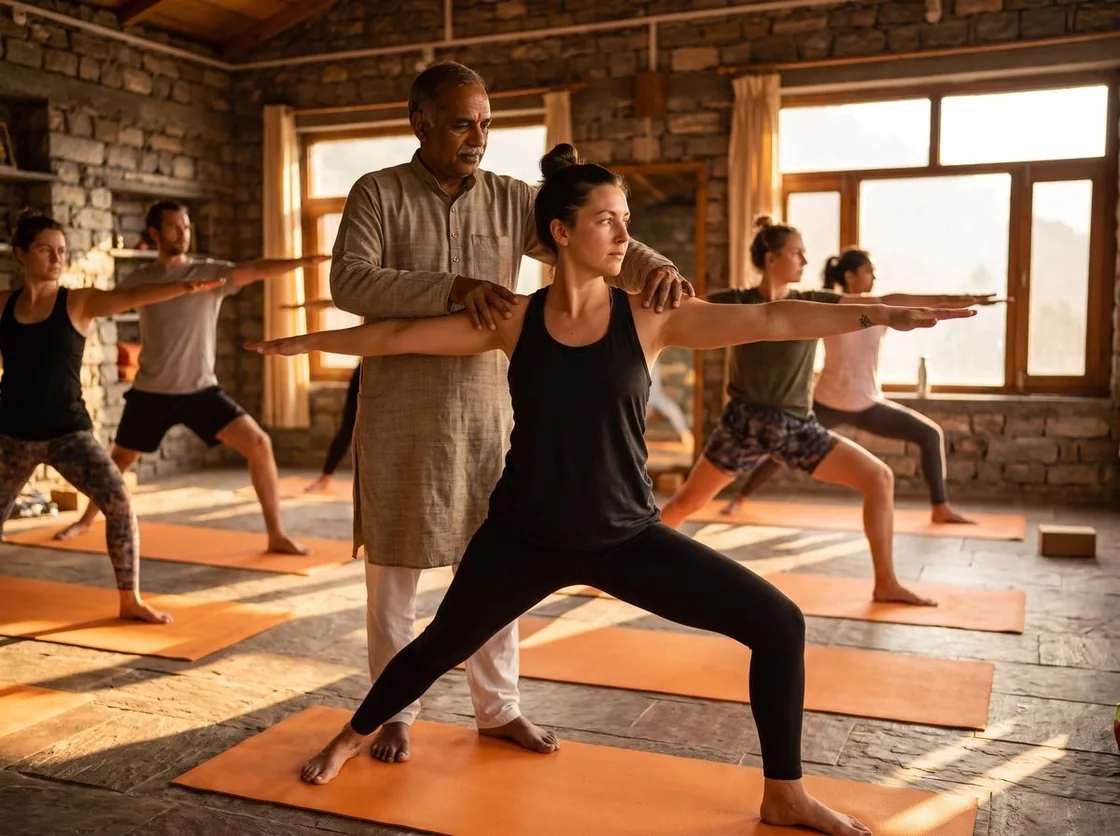
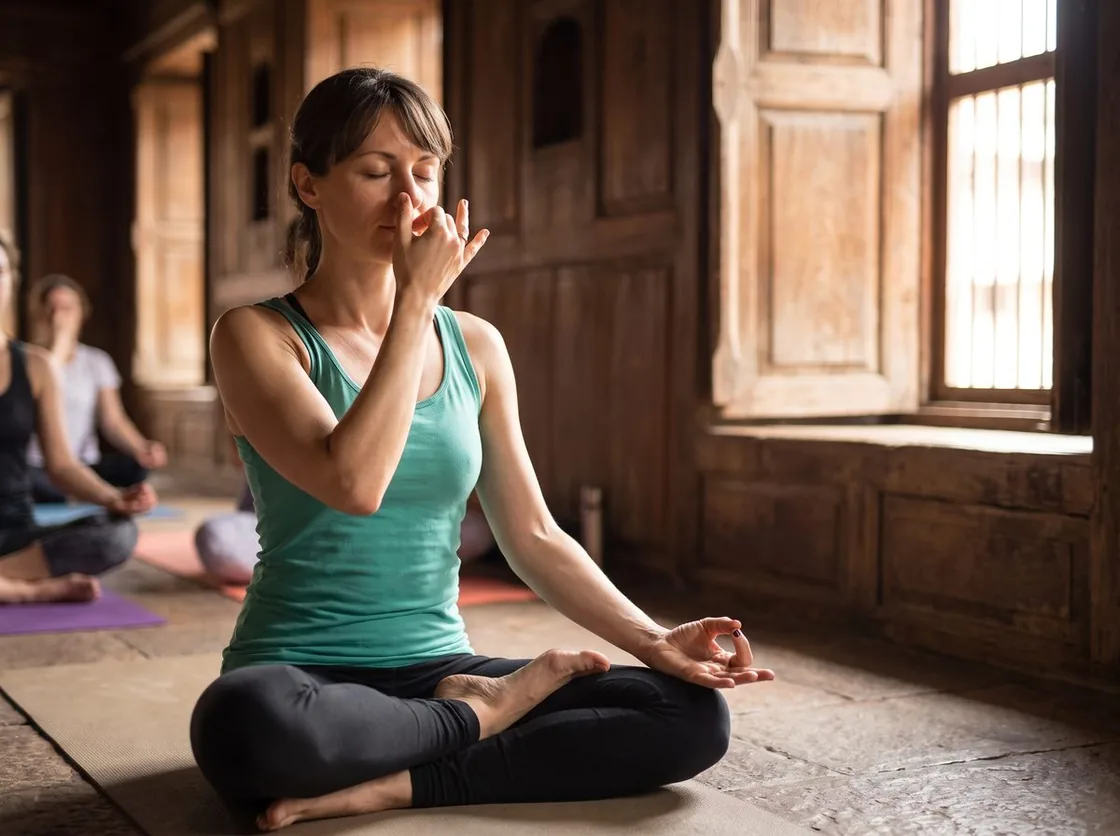
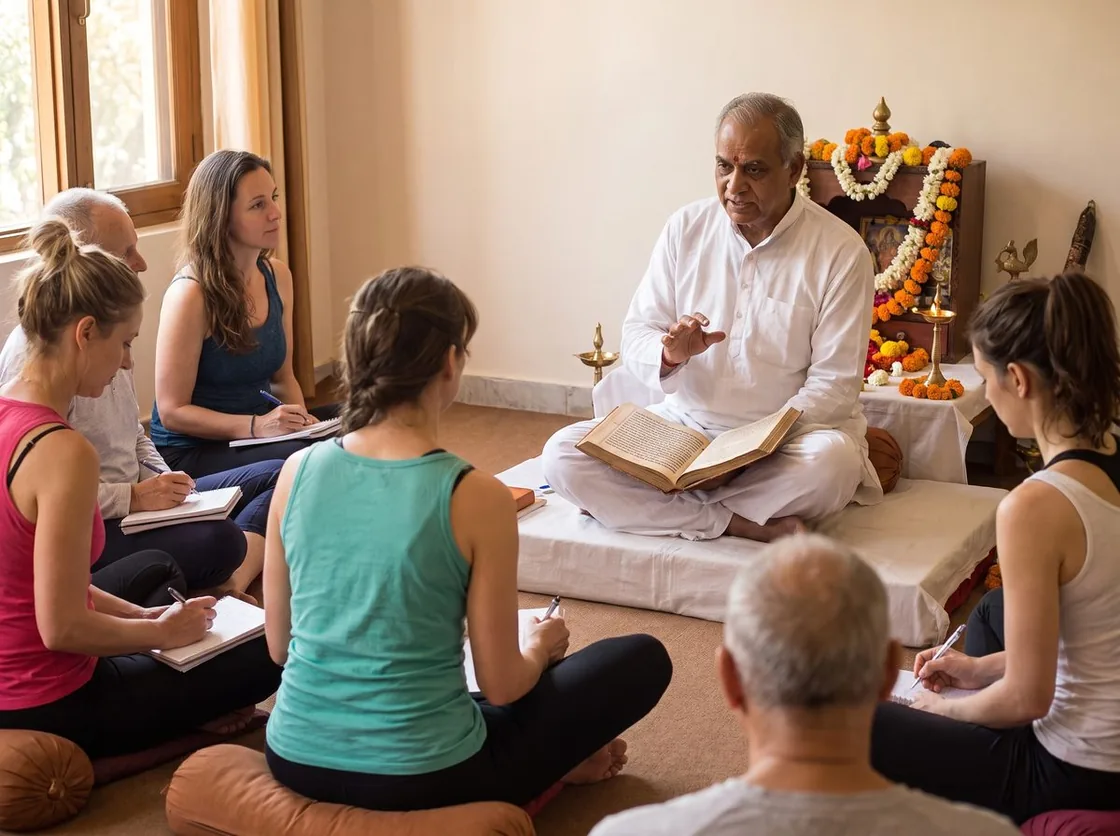
The training runs on a fixed daily rhythm, because showing up for a practice at the same hour every morning is itself part of what a beginner needs to learn before anything else clicks into place. Sunday is the day off, and most students spend it exploring Rishikesh or simply resting by the river before the next stretch of early starts.
| Time | Session |
|---|---|
| 05:30 | Wake up |
| 06:00 | Herbal tea |
| 06:30 | Hatha yoga practice |
| 08:00 | Pranayama |
| 09:00 | Brunch |
| 10:30 | Anatomy or philosophy, rotating through the week |
| 11:30 | Tea break |
| 11:45 | Teaching practice |
| 13:00 | Rest |
| 15:30 | Ashtanga or Vinyasa practice |
| 17:00 | Tea break |
| 17:15 | Guided teaching practice |
| 18:30 | Meditation or yoga nidra |
| 19:30 | Dinner |
| 21:00 | Lights out |
Sound healing is part of the shared rhythm of Rishikesh Nath Yogshala, not something reserved for the school's longer courses. Sessions with singing bowls are folded into the residential schedule, and 100 hour trainees take part alongside everyone else on-site, experiencing what it feels like to rest in savasana while a bowl is played nearby, at no extra cost.
For students who want to go further, the school also runs a separate sound healing program structured across three progressive levels, for those who want a specialisation beyond what any teacher training covers. You do not need to book that program separately to experience sound healing during your 100 hour training; it is already part of what you are here for.
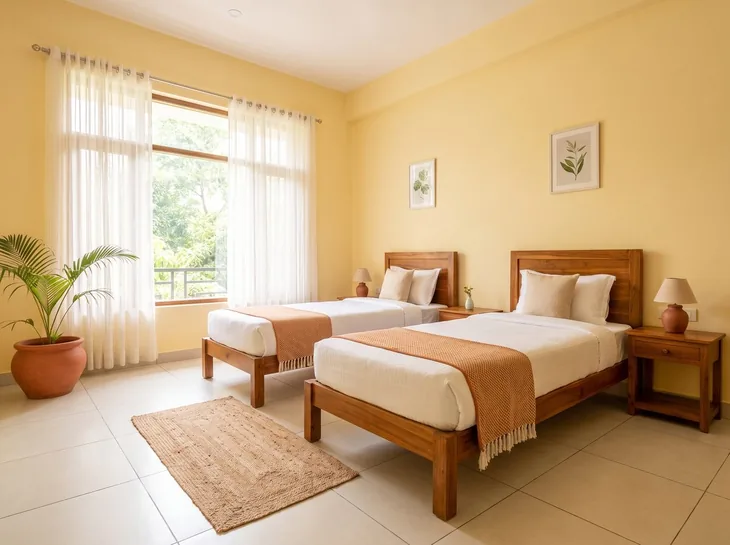
Accommodation is on-site, in separate dormitories for men and women, priced exactly the same regardless of which one you are staying in. Nobody pays more or less based on gender, and nobody is mixed into a dorm they did not choose. Rooms are simple and clean, with the basics you need for a short residential course. Full room layouts, including bathroom arrangements, are shown on the food and accommodation page. Wifi covers the school, and laundry access is available on-site, so two weeks of sweaty practice clothes are not something you are hand-washing in a sink.
Food is two sattvic meals a day, brunch and dinner, vegetarian, prepared in the school's own kitchen, with herbal tea between meals and filtered drinking water available at all times. Sattvic food, in the yogic sense, means simple, fresh and easy to digest, not heavy enough to make an early pranayama class miserable the next morning. If you have a genuine allergy or dietary restriction, raise it with the school before you arrive so the kitchen can plan around it.
A full walkthrough of the rooms, the kitchen and what a typical day of meals looks like, with photos, is on the food and accommodation page.

Finishing the 100 hour training earns you a completion certificate from Rishikesh Nath Yogshala, and it is worth being direct about what that certificate is and is not. It is not a Registered Yoga Teacher (RYT-200) credential with Yoga Alliance; there is no RYS-100 registration category for Yoga Alliance to recognise, because a 100 hour block sits below the threshold that credential requires. What you leave with is real, useful learning and a genuine starting point, not a shortcut to a qualification that normally takes twice the training.
If teaching is where this is heading for you, the natural next step is the 200 hour multistyle yoga teacher training, which is where the Yoga Alliance RYS 200 pathway actually lives. You do not start that course from zero. The Hatha foundation, the pranayama basics, the introductory philosophy and anatomy you cover here carry forward into the fuller curriculum, so your 100 hours is not time spent and then set aside, it is a starting point that carries forward on a longer path if you choose to keep walking it. There is no obligation to continue, and no pressure while you are here to commit to anything beyond the course you have already booked.
The nearest airport is Dehradun (DED), Jolly Grant Airport, which has direct flights from Delhi and a handful of other Indian cities. From Dehradun, Rishikesh is a straightforward taxi ride, and the school can help arrange transport if you share your flight details ahead of time. If you would rather travel partly by train, the nearest railhead is Haridwar, which has far better long-distance rail connections than Rishikesh itself and is a short drive from the school.
Because this course itself is short, arriving a day early is easy to arrange and well worth it: check in, get your bearings, and let your first session be your first real activity here rather than a rushed dash from the airport. Most nationalities can apply for an Indian e-Visa online in advance; requirements and eligible countries change, so check the current rules for your passport before you book flights.
What to pack for a first stay like this: comfortable, modest clothing you can move in for asana practice, since Rishikesh is a spiritual town and how you dress around the school and its temples matters more than it might at a yoga studio back home, a light jacket for cooler mornings and evenings, a reusable water bottle, and any personal medication you take, since finding a specific foreign brand locally is not guaranteed. If this is your first residential yoga course, bring your own mat if you already have one you like; a borrowed mat is a poor introduction to twice-daily practice.
Because your stay here is on the shorter side, you will most likely see only one season's weather rather than a shift between two, so check the forecast for your actual travel dates rather than packing for every season at once. Rishikesh sits at the base of the Himalayan foothills: expect light layers in spring and autumn, breathable, quick-dry clothing plus that jacket for the early starts in summer, and a proper warm layer, closed shoes and something thermal for the pre-dawn walk to the shala in winter, when the cold surprises visitors who picture Rishikesh as tropical year-round.
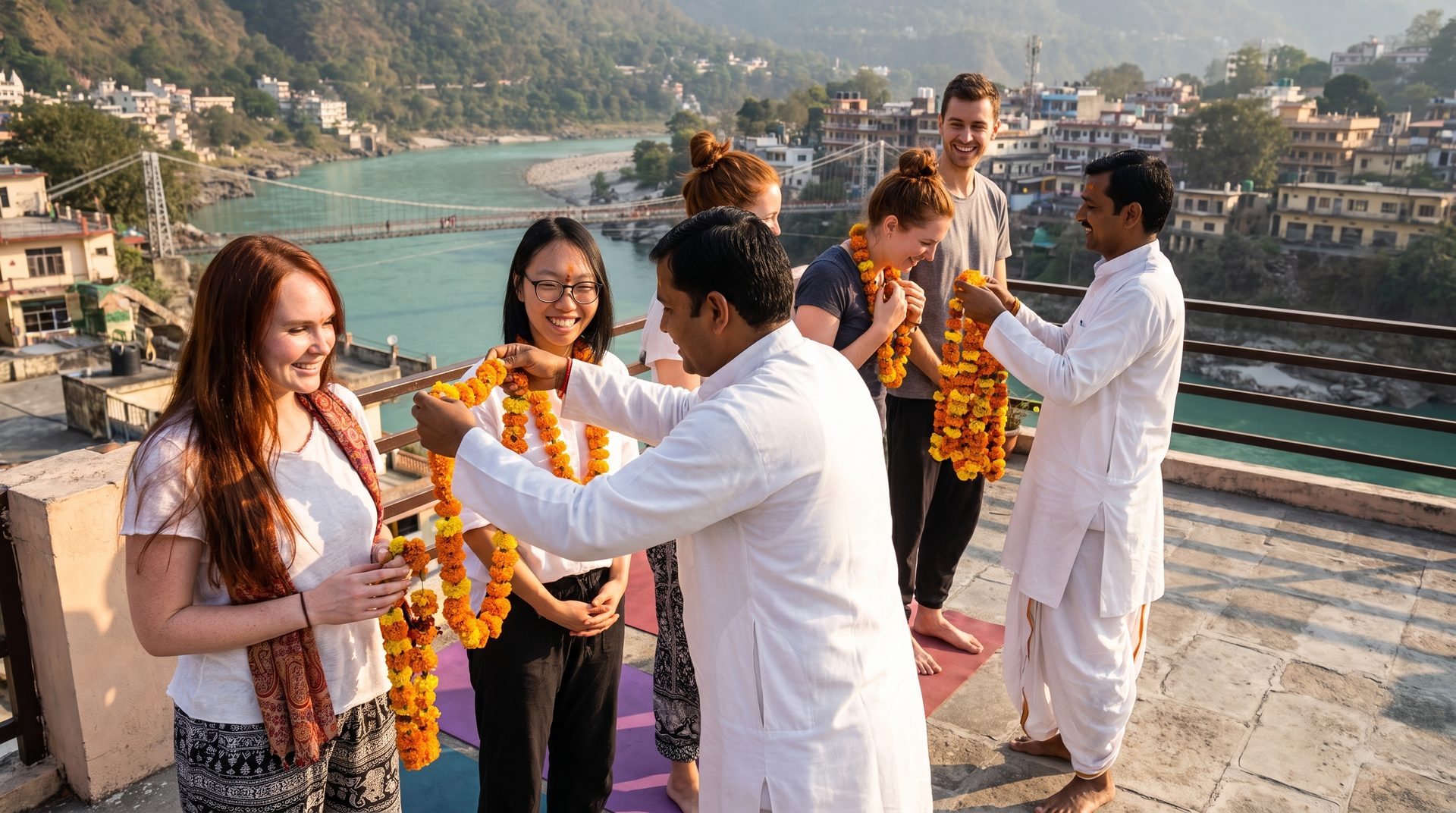
You do not need a prior yoga certification to join, and you do not need to already manage advanced postures. If you have practised on and off for a while, or you are simply curious and disciplined enough to show up early every morning for a set stretch of days, this course is built for you. It is also a sensible way to find out whether the longer commitment of a full teacher training is something you actually want before you book it.
Be honest with yourself about what this course is not. It is not a shortcut to a Yoga Alliance RYT-200 credential, and it is not built for someone who already holds a solid asana practice and wants advanced work; if that describes you, the 200 hour training will serve you better from the start. It is also not a wellness holiday with a few yoga classes attached. Mornings start early and the days have structure, even across a shorter residency, and students who get the most from it are the ones who arrive expecting to be taught, not entertained.
Both courses are taught by the same core team, on the same site, to the same honest-pricing standard. The real question is not which one is better, it is which one matches where you are right now and how much time you have to give it. If you are still deciding, the table below lays out the practical differences side by side.
| 100 Hour Foundation | 200 Hour Multistyle | |
|---|---|---|
| Time away from home | A shorter stay, built to fit a tighter travel window | A longer residency, best planned as a dedicated block of time |
| Curriculum depth | Foundation only: Hatha, an introduction to Ashtanga and Vinyasa, pranayama, and the basics of anatomy and philosophy | Full multistyle training across Hatha, Ashtanga, Vinyasa, Iyengar-influenced alignment and Yin, with pranayama, philosophy, anatomy and teaching methodology covered in depth |
| Certification outcome | A school completion certificate; not a Yoga Alliance RYT-200 registration on its own | Eligible to register as a Yoga Alliance RYT-200 with Yoga Alliance after completion |
| Who it suits | Someone testing whether teaching is a path worth pursuing, or working with less time to give right now | Someone ready to commit to becoming a working, credentialed yoga teacher |
Whichever you choose, nothing here is wasted. Students who start with the 100 hour and later move on to the full 200 hour training carry their foundation forward rather than starting over.
No. You do not need a prior certification or years of practice. Some familiarity with sitting cross-legged and moving through basic postures makes the first few days easier, but this course is built as an entry point, including for people who are new to structured practice.
Accommodation for the full residency, two sattvic meals a day plus herbal tea, filtered drinking water, your course manual and printed materials, a guided Ganga aarti visit, wifi, laundry access and your course completion certificate. What is billed separately is listed in the table above.
No. There is no Yoga Alliance registration category for a 100 hour training. You receive a completion certificate from Rishikesh Nath Yogshala. If you want a Yoga Alliance-recognised RYT-200 credential, that pathway runs through the school's 200 hour training.
Yes. If you continue on to the 200 hour multistyle training afterward, the Hatha, pranayama, introductory philosophy and anatomy you cover in the 100 hour course carry forward rather than being repeated from scratch.
Hatha yoga, an introduction to Ashtanga and to Vinyasa, pranayama, an entry point into yoga philosophy, the basics of anatomy, and supervised teaching practice. The full module-by-module breakdown is set out earlier on this page.
The nearest airport is Dehradun (DED), Jolly Grant Airport. If you are arriving by train instead, the nearest railhead is Haridwar, which has stronger long-distance rail connections than Rishikesh itself.
No. Men and women stay in separate dormitories, and both are priced exactly the same. Nobody pays more to be housed separately.
Training runs on a fixed schedule from an early wake-up through asana, pranayama, lecture blocks and an evening meditation or yoga nidra session, with Sunday off. The full timetable is set out in the day-in-the-shala table above.
If you are new to structured practice, short on time right now, or want to test whether teaching is a path worth pursuing, start with the 100 hour. If you are ready to commit to becoming a certified, Yoga Alliance-eligible teacher, go straight to the 200 hour training. The comparison table above sets out the practical differences.
You can book directly through the school's booking page, where the current deposit amount, payment options and next available batch are shown. If you have questions before committing, the general FAQ page and the teachers page are both good places to look, or you can reach out to the school directly.
14 days · 2nd & 15th monthly · all-inclusive of accommodation, two sattvic meals a day, study material, weekend excursions and Yoga Alliance certification.
| Batch dates | Dorm | Twin shared | Private |
|---|---|---|---|
| Batch dates15 – 28 October 2026Filling fast | Dorm$275 | Twin shared$660 | Private$880 |
| Batch dates2 – 15 November 2026Limited seats | Dorm$275 | Twin shared$660 | Private$880 |
| Batch dates15 – 28 November 2026 | Dorm$275 | Twin shared$660 | Private$880 |
| Batch dates2 – 15 December 2026 | Dorm$275 | Twin shared$660 | Private$880 |
| Batch dates15 – 28 December 2026 | Dorm$275 | Twin shared$660 | Private$880 |
| Batch dates2 – 15 January 2027 | Dorm$275 | Twin shared$660 | Private$880 |
Men and women have separate dormitories at the same price. A small deposit reserves your place; the balance is payable by PayPal or in cash on arrival.
Unscripted reviews filmed at the shala. Each one links to the original post.
Short clips from the shala: the opening ceremony, morning practice, Jal Neti and a cave visit.
Founder & Lead Yoga Teacher
Mayuri Shewale is the heart and soul of Rishikesh Nath Yogshala, bringing over 15 years of dedicated teaching experience to every class. As the founder and lead teacher, she has guided thousands of students from around the world through transformative yoga journeys that extend far beyond the mat.
Co-Founder & Philosophy Teacher
Rahul Badoni brings a rich understanding of yoga philosophy and ancient wisdom to Rishikesh Nath Yogshala. With over 12 years of dedicated practice and teaching, Rahul specializes in the philosophical and spiritual dimensions of yoga, helping students understand not just the physical practice, but the deeper purpose behind it.
Aerial Yoga Specialist
Priya Sharma is our resident aerial yoga specialist, bringing creativity, playfulness, and expert technique to the practice of yoga in hammocks. With extensive training in both traditional yoga and aerial arts, Priya has developed a unique teaching style that combines strength, flexibility, grace, and fun.
Meditation Master
Swami Anand brings over 20 years of dedicated meditation practice and teaching to Rishikesh Nath Yogshala. Having spent years in ashrams and meditation centers across India, Swami Anand offers students authentic guidance in the art of meditation, pranayama (breathing techniques), and inner awareness.
See more of the food & accommodation, browse the photo gallery, or read what our graduates say — 4.9★ from 113 Google reviews.
Ask us anything about dates, fees or what to bring — we usually reply within a few hours.
