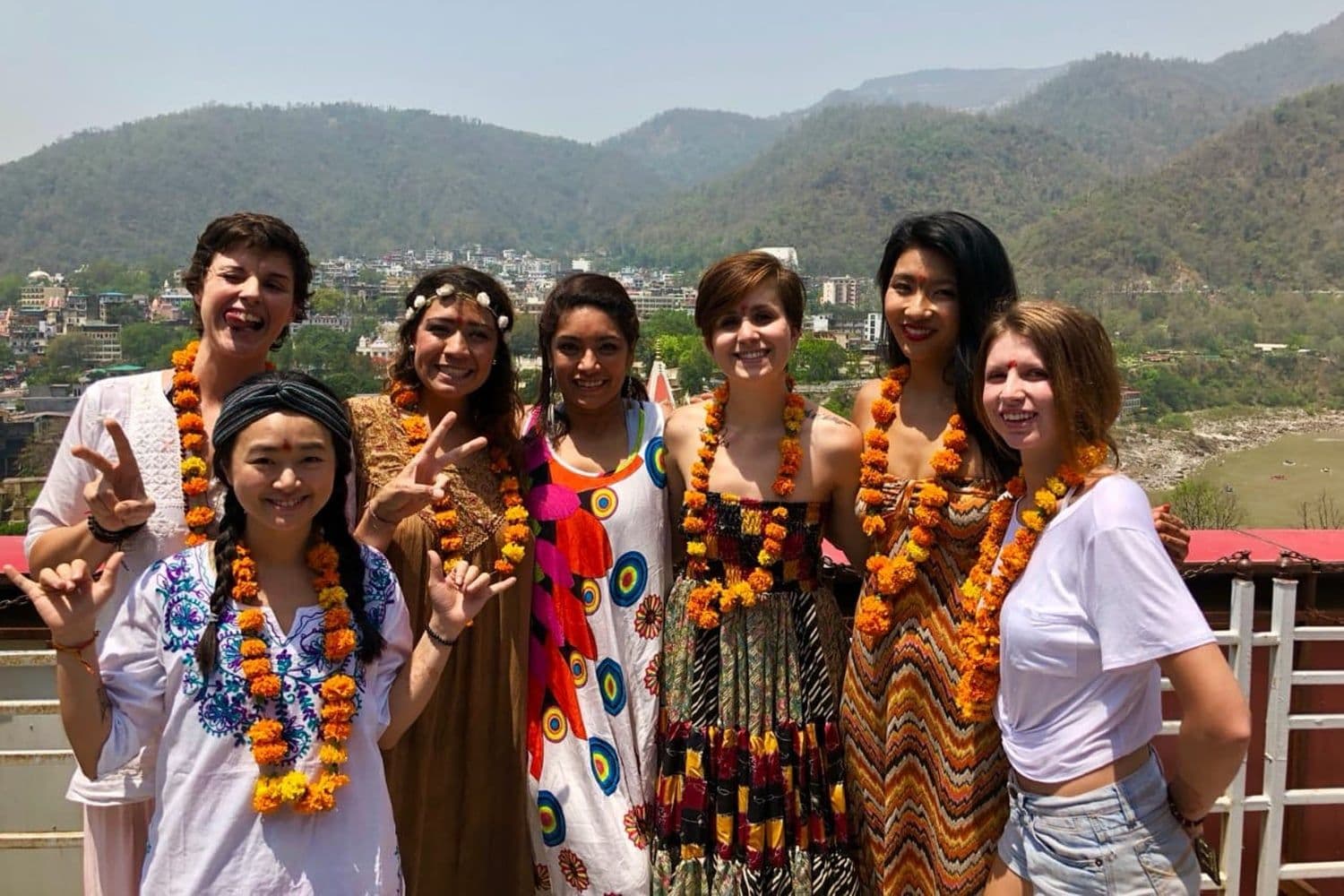
The 7 day yoga retreat at Rishikesh Nath Yogshala costs $250 all-inclusive. It begins every Monday, all year round, and the price covers accommodation, three sattvic meals a day, daily yoga, pranayama and meditation, and the Himalayan excursions. Shorter 3 and 5 day retreats follow the same daily rhythm.
A week is the length the school recommends to anyone who wants a retreat to change something rather than just interrupt a busy schedule. Seven days is long enough to learn the morning practices properly, settle into the rhythm of the shala, see the hills and the river, and find out whether a longer stay or a teacher training is what you actually want. The retreat begins every Monday, all year round, at Laxman Jhula in Rishikesh, and the price you see above is the whole price: your room, three sattvic meals a day, every class, and the excursions.
Every day follows the same shape: an early start, herbal tea, shatkarma and a morning asana and pranayama session before breakfast, a technique class in the afternoon, free time, and a guided meditation or yoga nidra in the evening before dinner. What changes across the week is where the practice can go, and which day the group leaves the building. The excursion days move with the weather and the group, so read the table as the usual pattern rather than a fixed timetable.
| Day | Morning | Afternoon | Evening |
|---|---|---|---|
| Monday | Arrival, a walk around the school, and the first taught session: how the mornings work | Settle in, rest, the lanes and cafes of Laxman Jhula | Orientation and a first guided meditation |
| Tuesday | Usually the first jal neti lesson, then Hatha asana and pranayama | Yoga fundamentals and technique, then free time | Guided meditation |
| Wednesday | Shatkarma, asana and pranayama | Technique class, then the river | Yoga nidra |
| Thursday | Shatkarma, asana and pranayama | The rest afternoon built into the middle of the week | Ganga aarti evening by the river, the usual evening for it |
| Friday | Shatkarma, asana and pranayama | Technique class, then free time | Guided meditation |
| Saturday | Usually the Himalayan foothill excursion | Return, lunch, rest | Yoga nidra |
| Sunday | A closing asana and pranayama session | Departure, or extra nights if you have arranged them | — |
Mornings are the work. Jal neti before practice clears the nose so that the breathing practices are comfortable, and the asana class is classical Hatha, held slowly, with the teacher adjusting rather than demonstrating from the front. The technique class is where you ask questions: how to sit for meditation, how one breathing practice differs from another, what a mantra is for. Afternoons are yours. Read about the cleansing practice on our page about jal neti benefits, side effects and how to do it daily, and, if you are curious about nature cure, about mud therapy.
Group outdoor excursions are part of the retreat, not an optional add-on you book separately. A Himalayan foothill excursion takes you out of the building and into the hills above Rishikesh, with Kunjapuri temple one of the destinations the school uses, and a Ganga aarti evening takes the group down to the river for the evening lamp ceremony, one of the more atmospheric things Rishikesh does after dark. A full week has room for both, and, depending on the group and the season, for a second outing on top.
The river itself is on the doorstep. Laxman Jhula is a few minutes' walk from the school, the sandy banks are where some morning sessions are held when the season allows, and the free afternoons are long enough to cross the bridge, sit by the water, or walk the lanes of cafes and shops on either side. You do not need to plan any of it; the excursions are the group's outings, and the afternoons are yours to spend at whatever pace the week has left you with.
Morning asana sessions build from joint-freeing warm-ups into standing and seated postures, with alignment cues that make each pose safer to hold. This is the backbone of every retreat day.
Breathing techniques and the traditional Hatha Yoga cleansing practices known as shatkarma are worked into the mornings, taught with the same care given to trainees on the residential courses, at a gentler pace.
Evenings wind down with guided meditation or yoga nidra, a deeply relaxing lying-down practice, so the day closes with stillness rather than another active session.
The technique class is where the ideas behind the practice come up: what the breath is doing, what a mantra is for, how the morning practices fit together. Questions are welcome; there is no assessment.
Retreat guests stay in the same rooms and eat from the same sattvic kitchen as the school's teacher trainees; a retreat is not a smaller version of the experience, it is simply less time inside it. Accommodation is included in the price. Tell the school when you book if you would prefer a twin-shared or private room and they will confirm what is available for your week. Men and women have separate dormitories. Meals are three vegetarian sattvic meals a day with herbal tea and filtered drinking water; tell the kitchen in advance about allergies or a vegan diet. There is more on the rooms and the food on our food and accommodation page.
Flights, visa, travel insurance, meals outside the school and extra nights are your own arrangement, the same as for the teacher trainings. A note on pickup: free airport pickup from Dehradun is included with the school's residential teacher trainings; ask the school when you book whether the same applies to your retreat dates.
For people visiting Rishikesh who want a structured week rather than drop-in classes; complete beginners, because every practice is taught from the start; practitioners who want a reset of their own routine; and anyone weighing up a teacher training who would like to spend a week at the school first. It is also a meditation retreat as much as a yoga one: there is a seated practice every morning and a guided meditation or yoga nidra every evening.
It is not a silent retreat. There is teaching, conversation and a shared table, so if you want silence for the full week a Vipassana centre will suit you better. It is not a spa: the rooms are clean and simple, the food is sattvic and vegetarian, and the days start early. Beginner, intermediate and advanced practitioners are all welcome.
Extra nights before or after your retreat are not included in the standard package but can usually be arranged; ask when you book so the school can confirm room availability. If you want a certificate at the end of a longer stay, the 100 hour yoga teacher training in Rishikesh is the foundation course: a full timetable, anatomy, philosophy and teaching methodology, and a certificate at the end. Choose the retreat to rest and learn; choose the 100 hour course if you want to begin the path to teaching. The 3 and 5 day retreats follow the same daily rhythm if a week is more than you have.
A new retreat begins every Monday, all year round, so you can join whichever week suits your travel. Send the school the Monday you want on WhatsApp, or use the enquiry form, and they will confirm availability. A registration fee holds your place. Registration fees are generally not refundable outright, but the school works with guests to reschedule to a later date rather than simply losing the payment. The fee row and the current price are shown further up this page.
Not sure whether a week or a training is right for you? Message the school on WhatsApp with your dates and your experience so far, and a teacher will reply with an honest recommendation.
The price shown at the top of this page is all-inclusive: your room, three sattvic meals a day, every yoga, pranayama, shatkarma, meditation and technique class, and the excursions. Flights, visa, insurance and meals outside the school are extra. There are no discounts and no hidden charges; the price you see is the price everyone pays.
No. Every practice, the asana class, jal neti, pranayama, meditation and yoga nidra, is taught from the beginning. Experienced practitioners are welcome too; the technique class is where the teacher goes deeper for those who want it.
An early start with herbal tea, shatkarma and a morning asana and pranayama session before breakfast, a technique class in the afternoon, free time or the day's excursion, and a guided meditation or yoga nidra in the evening before dinner. Sunday is departure day.
Yes. Every day has a seated practice in the morning session and a guided meditation or yoga nidra in the evening, and the technique class covers how to sit, breathe and use a mantra. It is not a silent retreat; there is teaching and conversation.
Extra nights can usually be arranged; ask when you book. If you want a certificate at the end of a longer stay, look at the 100 hour yoga teacher training instead.
Comfortable clothes you can practise in, a light layer for early mornings and evenings, walking shoes for the foothill excursion, any medication you take, and a reusable water bottle. Ask what is provided when you book. Rishikesh is a dry town: no alcohol or meat.
Begins every Monday, all year round · all-inclusive of stay, three meals a day and excursions.
Founder & Lead Yoga Teacher
Mayuri Shewale is the heart and soul of Swaastik Yog School, bringing over 15 years of dedicated teaching experience to every class. As the founder and lead teacher, she has guided thousands of students from around the world through transformative yoga journeys that extend far beyond the mat.
Co-Founder & Philosophy Teacher
Rahul Badoni brings a rich understanding of yoga philosophy and ancient wisdom to Swaastik Yog School. With over 12 years of dedicated practice and teaching, Rahul specializes in the philosophical and spiritual dimensions of yoga, helping students understand not just the physical practice, but the deeper purpose behind it.
Aerial Yoga Specialist
Priya Sharma is our resident aerial yoga specialist, bringing creativity, playfulness, and expert technique to the practice of yoga in hammocks. With extensive training in both traditional yoga and aerial arts, Priya has developed a unique teaching style that combines strength, flexibility, grace, and fun.
Meditation Master
Swami Anand brings over 20 years of dedicated meditation practice and teaching to Swaastik Yog School. Having spent years in ashrams and meditation centers across India, Swami Anand offers students authentic guidance in the art of meditation, pranayama (breathing techniques), and inner awareness.
See more of the food & accommodation, browse the photo gallery, or read what our graduates say — 4.9★ from 113 Google reviews.
Ask us anything about dates, fees or what to bring — we usually reply within a few hours.
