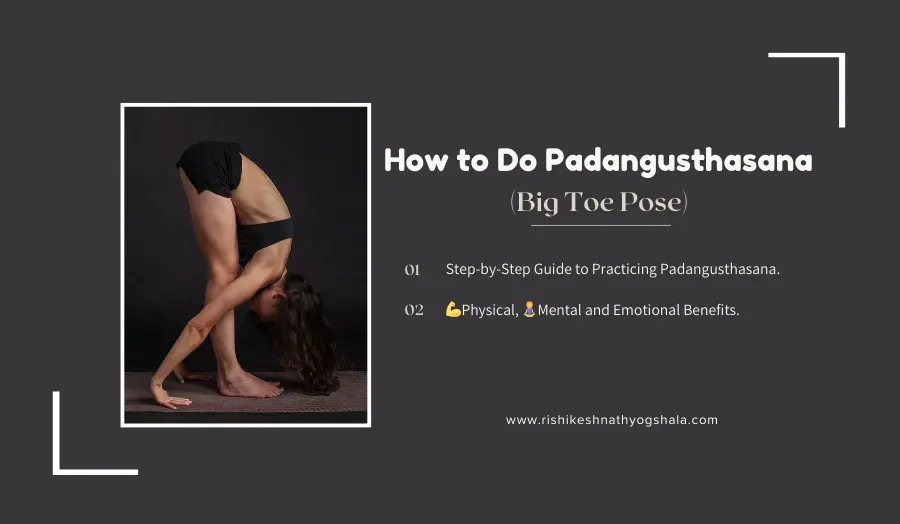
Big Toe Pose, or Padangusthasana, is a standing forward bend in which you fold from the hips and hold each big toe with the index and middle fingers. It stretches the hamstrings, calves and lower back and is usually held for 5 to 10 slow breaths. It is beginner friendly with soft knees or a strap, but people with lower back injuries, high blood pressure or who are pregnant should skip it, or modify it only under a teacher's guidance.
Yoga is full of powerful yet simple poses that can bring real benefits to both your body and mind. One such pose is Padangusthasana, or the Big Toe Pose. At first glance it might seem basic, but this forward bend holds a lot more than meets the eye. It is gentle enough for beginners but effective enough to support deep flexibility and inner calm.
In this blog, we will walk you through what Padangusthasana is and how to do Padangusthasana step by step, along with helpful tips and the benefits it offers.
| Step | Action | Cue |
|---|---|---|
| 1 | Stand in Tadasana, feet hip-width apart | Weight even across both feet |
| 2 | Inhale, lengthen the spine | Lift the chest, reach through the crown |
| 3 | Exhale, fold from the hips | Hinge at the hips, not the waist |
| 4 | Hold the big toes | Index and middle fingers loop the toes, thumbs outside |
| 5 | Inhale, lift halfway | Flat back, look slightly ahead |
| 6 | Exhale, deepen the fold | Elbows out, pull gently on the toes |
| 7 | Hold for 5 to 10 breaths | Soften a little more on each exhale |
| 8 | Inhale to come up | Release the toes, rise with a straight back |
Padangusthasana is a standing forward bend in which you clasp your big toes with your fingers. The name comes from Sanskrit:
It is a foundational posture in many yoga styles and works on the whole of the lower body and spine. It also encourages deep, conscious breathing and mental clarity. You will sometimes see the name shortened to Angusthasana; in most classes that means this same standing big toe hold, though a few Hatha texts use the shorter word for a tiptoe balance.
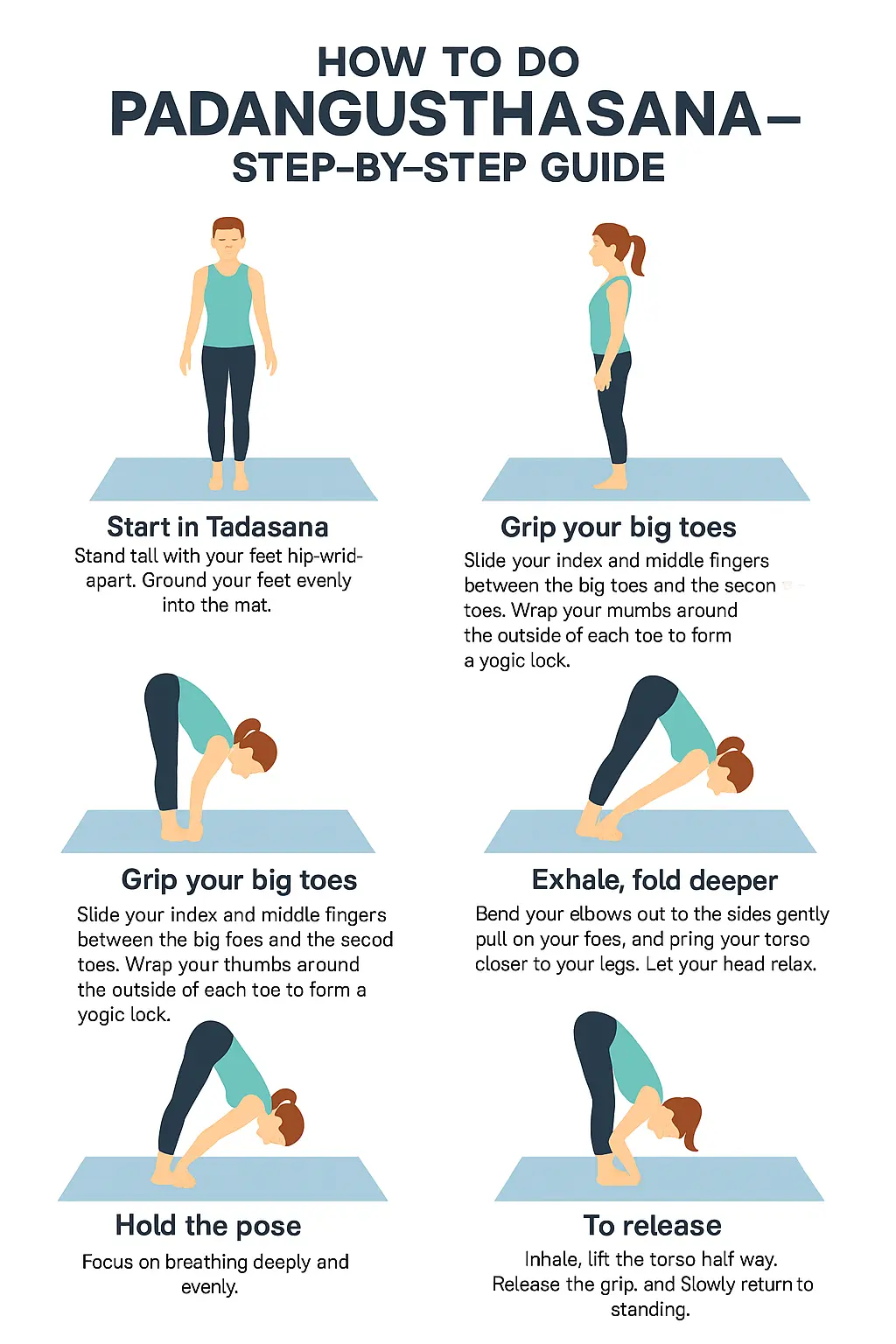
Stand upright with your feet about hip-width apart. Distribute your body weight evenly across both feet, grounding into the earth.
Engage your thighs and gently lift your chest. Reach up through the crown of your head to create a long, tall spine.
Hinge at your hips, not your waist, and fold your torso forward. Keep your spine extended rather than rounded as you move into the bend.
Once your hands reach your feet, use your index and middle fingers to loop around each big toe. Wrap your thumbs around the outside for a secure grip.
Extend your arms and lengthen your spine forward. Look ahead slightly and create space in the torso.
Bend your elbows outward and gently pull on your toes to draw your upper body closer to your legs. Allow your head to hang and relax completely.
Stay in the pose and breathe deeply. With each exhale, try to soften and sink a little deeper into the stretch.
Inhale, lift your torso halfway. Let go of your toes and slowly rise back up to standing with a straight back.
If you practise Ashtanga Vinyasa, you already know this pose well. In the Primary Series, Padangusthasana is the first posture of the standing sequence, coming straight after Surya Namaskar A and B and followed by Padahastasana (hands under the feet). From Samasthiti you step the feet hip-width apart, place the hands on the hips, inhale to look up, exhale to fold and take the toes, inhale to lift the head with a flat back, then exhale and fold for five breaths. Because it opens the hamstrings early, the rest of the standing poses feel easier.
Ashtanga and classical Hatha are both taught on our 200 Hour Yoga Teacher Training in Rishikesh, where you learn the standing sequence pose by pose with alignment corrections from the teacher. Graduates who already hold an RYT-200 and want to go deeper into the series move on to the 300 Hour Yoga Teacher Training in Rishikesh.
| Area | What the pose may help | Caution |
|---|---|---|
| Hamstrings and calves | Deep stretch along the back of the legs | Keep the knees soft if tight |
| Lower back and spine | Lengthens the spine, eases stiffness | Skip with a back injury or disc problem |
| Digestion | Gentle abdominal pressure, traditionally said to aid digestion | Practise on an empty stomach |
| Nervous system | Head below the heart tends to feel calming | Avoid long holds with high blood pressure or dizziness |
| Balance and posture | Trains even weight through both feet | Use a wall or strap if unsteady |
If you are new to yoga and would like a teacher's eye on your forward bends, the 14-day 100 Hour Yoga Teacher Training in Rishikesh covers foundation poses like this one with daily alignment practice.
Padangusthasana might seem simple, but it offers a surprising depth, both physically and mentally. It is more than just touching your toes; it is about connecting with your breath, calming your thoughts, and opening up the body with intention and care.
Whether you are a yoga newbie or a seasoned practitioner, adding Big Toe Pose to your routine can help you feel more grounded, flexible, and centred.
If you want to learn how to do any yoga posture exactly, you can join our 100 Hour and 200 Hour Online Yoga Teacher Training Course, which teach the right way to practise and teach each asana through live online classes.
Padangusthasana, or Big Toe Pose, is a standing forward bend where you grasp your big toes, stretching the hamstrings, calves, and spine. The name comes from the Sanskrit pada (foot), angustha (big toe) and asana (pose). It appears early in the Ashtanga standing sequence and in most Hatha classes as a warm-up for deeper forward bends.
It stretches the hamstrings, calves and lower back, and may help improve flexibility in the spine and legs. Traditionally it is also said to support digestion by gently pressing the abdominal organs, and the head-below-heart position tends to calm the mind, which many practitioners find eases stress, anxiety and mental fatigue.
Individuals with back injuries, disc problems or serious hamstring strains should skip it or practise only with a teacher. Those with high blood pressure, vertigo or dizziness should avoid long holds, and pregnant practitioners should keep the fold gentle or leave it out. If in doubt, consult a healthcare professional before practising.
Yes, beginners can practise it. If reaching the toes is challenging, use a yoga strap or bend the knees slightly to maintain proper form. Keep the spine long rather than rounding to reach, warm up the hamstrings first with a gentle forward bend, and build up the hold gradually over a few weeks.
Hold the pose for 5 to 10 deep breaths, focusing on steady breathing and gradually deepening the stretch without strain. In the Ashtanga standing sequence it is held for five breaths; in a slower Hatha class you can stay for ten or a little longer if the breath stays smooth. Come up on an inhale with a flat back.
Angusthasana is often used as a short name for Padangusthasana, the standing big toe hold described here. In some Hatha texts the same word also names a tiptoe balance done squatting on the balls of the feet. If you were looking for the standing forward bend holding the big toes, Padangusthasana is the full and more common name.
Have a question about Big Toe Pose, or would you like a teacher to check your forward bend in person in Rishikesh? Message us on WhatsApp and we will get back to you.
Welcome to our transformative 22 Days 200 Hour Hatha, Ashtanga, Vinyasa Flow, Iyengar, Yin Yoga and Kundalini Yoga Teacher Training Course with Sound Healing Sessions in Rishikesh, India.
Read more about the 200 Hour course or Book Now
The 300 hour yoga teacher training course programme is all about gaining perfection, so you must choose a school that is listed among the top 10 yoga schools.
Read more about the 300 Hour course or Book Now
Ask us anything about dates, fees or what to bring — we usually reply within a few hours.
