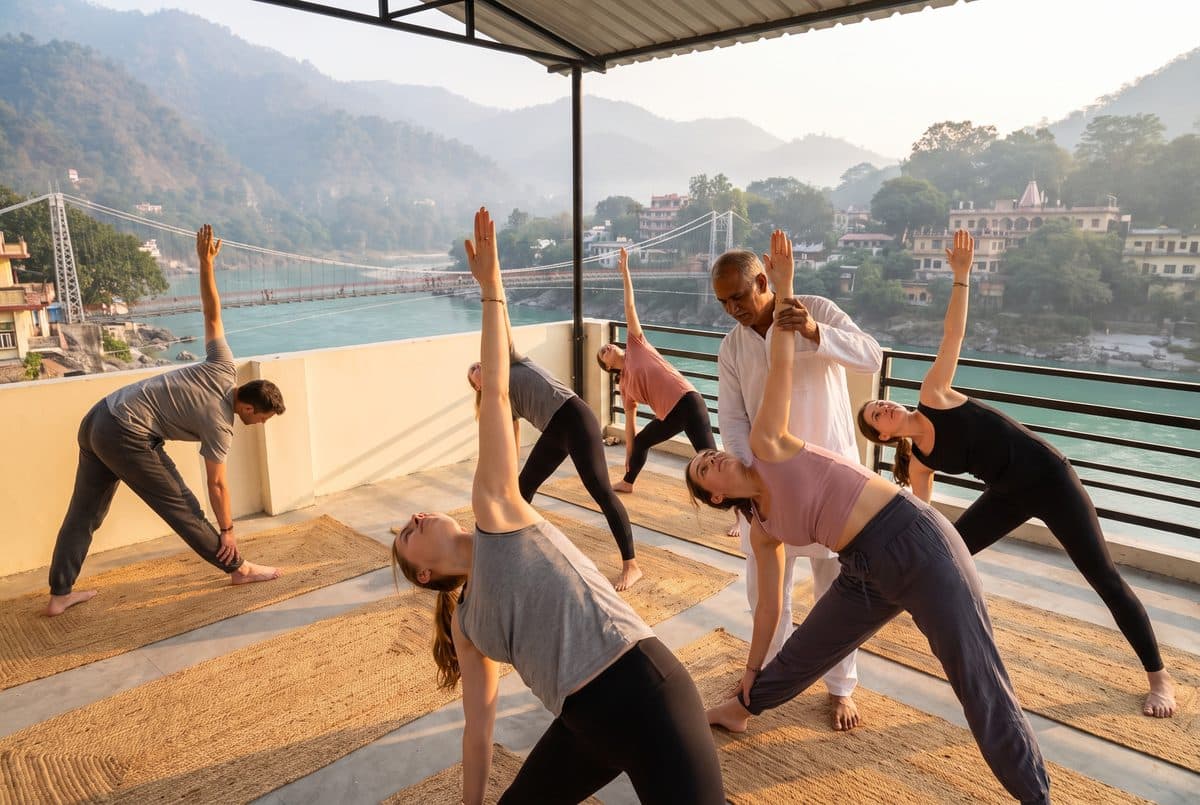
Hatha Yoga is the classical, body-based branch of yoga. In Sanskrit, Ha means sun and Tha means moon, so Hatha Yoga is the practice that balances the body's opposing energies; the word hatha also means force or effort, pointing to steady, disciplined practice. A Hatha class combines held postures (asanas), breathing techniques (pranayama), cleansing practices (shatkarmas), mudras, bandhas and meditation. Practised regularly it may improve flexibility, strength, posture, breathing, sleep and stress levels, and it is the foundation of most modern yoga styles.
Hatha Yoga is a holistic practice that balances body and mind through physical postures, breathing exercises and meditation techniques. If you want to learn and master Hatha Yoga with a teacher, you can join our Hatha Yoga Teacher Training in Rishikesh.
| Element | What it is | Benefit |
|---|---|---|
| Asana | Held postures such as Tadasana, Bhujangasana and Vrikshasana | Flexibility, strength, balance, posture |
| Pranayama | Breath control such as Nadi Shodhana, Kapalbhati and Bhramari | Calmer nervous system, fuller breathing |
| Shatkarma | Six cleansing kriyas such as Jal Neti and Trataka | Clear nose, eyes and digestion; ready for pranayama |
| Mudra | Hand and body gestures that direct energy | Focus and steadiness in meditation |
| Bandha | Muscular locks: Mula, Uddiyana, Jalandhara | Core control, steadier breath |
| Meditation | Sitting practices such as Trataka and mantra | Mental clarity, less stress, better sleep |
In the vast ocean of yoga practices, Hatha Yoga stands out as one of the most ancient and accessible forms. Rooted in traditional Indian philosophy and practices, Hatha Yoga is not just about physical postures (asanas); it is a comprehensive approach that includes breathing techniques (pranayama), meditation and ethical disciplines. This holistic practice aims to harmonise the body, mind and spirit, making it a powerful tool for overall well-being. In this blog, we will delve into the essence of Hatha Yoga, its origins, key components and the myriad benefits it offers.
The term "Hatha" comes from two Sanskrit words: "Ha", meaning sun, and "Tha", meaning moon. Symbolically, Hatha Yoga aims to balance these opposing forces within the body and mind. This balance is achieved through a series of physical postures, breathing exercises and meditation techniques designed to cleanse, align and strengthen the body, while calming the mind.
There is a second, older reading of the word. In Sanskrit, hatha on its own means force, effort or persistence, so Hatha Yoga can also be read as "the yoga of effort": a method that works through the body, with discipline, to still the mind. Both meanings point to the same idea. The sun energy (pingala nadi, the active, heating side) and the moon energy (ida nadi, the cooling, receptive side) are brought into balance so that prana can move freely through the central channel, sushumna. In plain terms, Hatha Yoga is the physical preparation for meditation.
Hatha Yoga has its roots in ancient Indian traditions and texts. One of the foundational texts is the "Hatha Yoga Pradipika", written by Swami Swatmarama in the 15th century. This text, along with other classical works like the "Gheranda Samhita" and "Shiva Samhita", outlines the principles and practices of Hatha Yoga. The Pradipika opens by honouring the Nath yogis Matsyendranath and Gorakshanath, who are traditionally credited with systematising Hatha Yoga, and it is this Nath lineage that our school in Laxman Jhula follows.
Hatha Yoga is part of a broader yogic system that includes Raja Yoga, Karma Yoga, Bhakti Yoga and Jnana Yoga. While Raja Yoga focuses on meditation and the mind, and Karma Yoga emphasises selfless action, Hatha Yoga is primarily concerned with the physical body as a means to prepare for deeper spiritual practices.
A typical Hatha class moves through these components in order: a short warm-up or cleansing practice, a sequence of held postures, pranayama and a short seated meditation. All of them are taught every day on our 22-day 200 Hour Yoga Teacher Training in Rishikesh, which begins on the 5th and 15th of every month, because classical Hatha is the core of that syllabus.
Most styles taught today grew out of Hatha Yoga, so the difference is mainly one of pace and structure. Hatha holds each posture for several breaths and teaches pranayama separately; Vinyasa links postures into a flowing sequence, one breath per movement; Ashtanga follows a fixed, physically demanding series in the same order every time.
| Feature | Hatha | Vinyasa | Ashtanga |
|---|---|---|---|
| Pace | Slow, postures held 5 to 10 breaths | Flowing, one breath per movement | Fast, vigorous |
| Sequence | Set by the teacher, changes by class | Creative, changes every class | Fixed series, same every time |
| Breath | Pranayama practised on its own | Ujjayi breath links the movement | Ujjayi with bandhas and drishti |
| Best for | Beginners, stress relief, learning alignment | Fitness, variety | Discipline, strength, athletes |
| Sweat level | Low to moderate | Moderate to high | High |
If you already hold a 200 hour certificate and want to go deeper into classical Hatha, pranayama and the bandhas, the 22-day 300 Hour Yoga Teacher Training in Rishikesh is the next step; it starts on the 5th and 15th of every month and is designed for RYT-200 graduates.
Hath yog (हठयोग) is the traditional physical yoga of India. "Ha" means surya, the sun, and "tha" means chandra, the moon, so hath yog is the practice that brings the sun and moon energies of the body, the pingala and ida nadis, into balance. It has six parts: asana (postures), pranayama (breath control), shatkarma (cleansing kriyas), mudra, bandha and dhyan (meditation). Its main text is the Hath Yog Pradipika of Swami Swatmarama. Practised daily, hath yog may keep the body flexible and strong, steady the breath and calm the mind, and it prepares the body for raj yog, which is meditation.
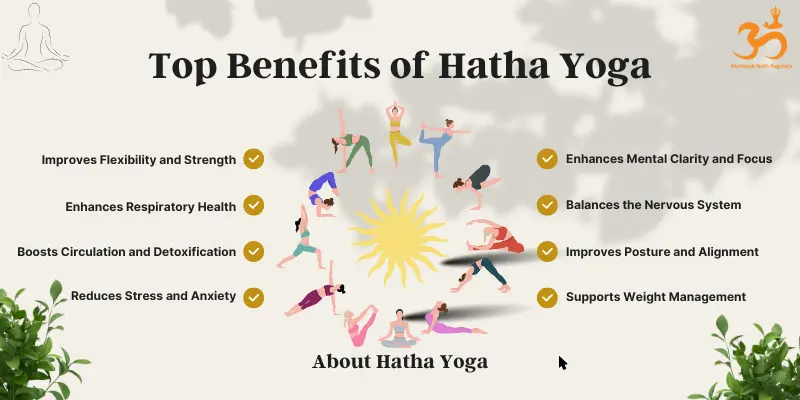
The practice of Hatha Yoga offers a multitude of benefits, encompassing physical, mental and spiritual aspects of health. Here are the top 10 benefits of Hatha Yoga:
For those new to Hatha Yoga, it is important to start gradually and listen to your body. Here are some tips for beginners:
Hatha Yoga is a powerful and versatile practice that offers numerous benefits for the body, mind and spirit. By incorporating physical postures, breathing techniques and meditation, Hatha Yoga provides a holistic approach to health and well-being. Whether you are seeking to improve flexibility, reduce stress or enhance mental clarity, Hatha Yoga can be a valuable addition to your daily routine. Embrace this ancient practice with an open heart and mind, and experience the transformative power of Hatha Yoga.
If you are thinking of starting a career in Hatha Yoga, you are in the right place. We run a Yogshala in Rishikesh registered with Yoga Alliance (RYS 200 and RYS 300). Beginners can start with our Hatha Yoga Teacher Training Course, one of the best places to build a serious Hatha practice from the ground up.
Hatha Yoga means the yoga of sun (ha) and moon (tha): a practice that balances the active and receptive energies of the body through postures, breath and meditation. The Sanskrit word hatha also means force or effort, so it is equally "the yoga of disciplined practice". It is the physical foundation for meditation and for most modern yoga styles.
Regular Hatha Yoga may improve flexibility, muscular strength, balance and posture, deepen and steady the breath, and lower day-to-day stress. Many practitioners also report better sleep, sharper concentration and a calmer mood. The benefits build slowly with consistent practice, three or more sessions a week, rather than from occasional long classes.
Hatha Yoga is the classical branch of yoga that uses the body as its main tool: asanas (postures), pranayama (breath control), shatkarmas (cleansing practices), mudras, bandhas and meditation. Its principal text, the Hatha Yoga Pradipika, describes it as a preparation for Raja Yoga, the yoga of meditation.
Yes. Hatha is usually the best starting point because postures are held slowly, with time to learn alignment and breathing before moving on to faster styles such as Vinyasa or Ashtanga. Start with basic standing and seated poses, keep sessions to 30 to 45 minutes, and learn from a qualified teacher if you have any medical condition.
Hatha Yoga holds each posture for several breaths and teaches pranayama as a separate practice, so classes are slower and more alignment-focused. Vinyasa links postures into a continuous flow, one movement per breath, which makes it faster and more cardiovascular. Vinyasa grew out of Hatha, so the postures are largely the same; the pace and structure differ.
For noticeable results, aim for three to five sessions a week of 30 to 60 minutes. Daily practice is traditional and safe for most healthy adults if the intensity is moderate, ideally in the morning on an empty stomach. Even 20 minutes of asana and pranayama every day builds more benefit than one long weekly class.
Have a question about Hatha Yoga, or want to know which course suits your level? Message us on WhatsApp and we will reply with the next start dates and a straightforward recommendation.
Welcome to our transformative 22 days 200 Hour Hatha, Ashtanga, Vinyasa Flow, Iyengar, Yin Yoga and Kundalini Yoga Teacher Training Course with Sound Healing Sessions in Rishikesh, India.
The 300 hour yoga teacher training course programme is all about gaining perfection, so you must choose a school that is listed among the top 10 yoga schools.
Rishikesh Nath Yogshala offers a 100 Hour Yoga Teacher Training course in Rishikesh, an intensive programme designed to give yoga teachers a strong foundation in classical practice.
Rishikesh Nath Yogshala provides 100 hour, 200 hour and 300 hour online yoga teacher training with live Zoom sessions and recordings, starting any month.
Ask us anything about dates, fees or what to bring — we usually reply within a few hours.
